BlackBerry Mercury hands-on
CES 2017
BlackBerry Mercury hands-on
Introduction
BlackBerry is nothing short of a legend in the mobile realm. The brand easily matches the popularity of other titans, such as Motorola or Nokia and is still synonymous with quality and enhanced security. The latter has been the staple of the Canadian company's existence, mostly as a trusted enterprise communication solutions provider over the last few years.
2016 marked a sea change in BlackBerry's way of bringing mobile phones to the end users. And the BlackBerry Mercury is the first device to signal the direction this change would be taking us.
BlackBerry went through some hard times in recent years. Their two most recent models in 2016 - the DTEK50 and the DTEK60 - were manufactured by the Chinese OEM TCL. At first, this move looked like BlackBerry was outsourcing the hardware manufacturing to a third-party, which was rather controversial. The controversy surrounding the two models continued as we discovered that both phones were merely re-badged versions of existing Alcatel models. Of course, both also came loaded with BlackBerry's trademark security and communication suite on the software end, but that didn't change things much. We felt somewhat cheated as consumers, and we began wondering what was going on.
Then it all became clear when an announcement in December 2016 stated BlacBerry would no longer manufacture hardware, choosing to focus on software and services instead. The rights to the mobile phone brand BlackBerry was being handed over to TCT, a fully owned US subsidiary of the Chinese TCL - the same guys that own and manufacture the Alcatel phones. It became clear that TCT/TCL will stand behind BlackBerry phones in the future and the BlackBerry Mercury is their first original product to come out as an embodiment of what the BlackBerry experience will stand for in the future.
The company was hesitant to reveal any hardware specifications at this point, which is quite unusual having in mind they already had a pre-production device on display at CES 2017. Nevertheless, we were glad to learn that TCT/TCL's plans for the BlackBerry devices go way beyond a simple rebranding scheme and they were really eager to make this abundantly clear at CES 2017.
So, is now the time to get our hopes up and just how far has the new partnership come? We thoroughly enjoyed every second of our hands-on time with the BlackBerry Mercury and can't wait to share our impressions on the next page.
Before we get anybody way too overexcited, the Mercury is still not here. In fact, the unit we explored is a very early prototype. TCL offered practically no information in regard to specs. In fact, most particulars were spared, but we did manage to extort little bits and pieces of information here and there, which we will share.
This is quite understandable, since even the Mercury moniker is not 100% certain at this point (We definitely like it, so, hopefully, it will stick). It appears TCL's intention was to make its exciting new BlackBerry plans known as early as possible and then start slowly spoon-feeding the specifics, as they get ironed out. This could potentially have some nice viral marketing implications as well.
Currently, the unofficial promise is that the device will be ready for a full and proper unveiling at MWC - less than two months from now. Like we said, until then, the guts of the Mercury are definitely subject to change and speculation on our end. Since we did already somewhat touch on the subject, as covered a few earlier leaks, back when it was only known as the DTEK70, here is what we currently know for a fact and some additional predictions.
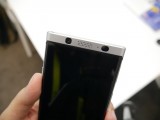
BlackBerry Mercury
As is clearly evident from the get-go, the Mercury is a throwback to classic BlackBerry design, combining a touchscreen and a physical keyboard. TCL was even reluctant to confirm our assumptions on the size of the panel, but we would put it somewhere in the 4.5 to 4.7-inch range. It comes with a nice and well-defined 2.5D curvature near the sides, for some extra visual style.
Underneath that, there is a trio of standard capacitive buttons. At first glance, this comes off as kind of redundant, given the qwerty keyboard. However, after using the Mercury for a bit, we have to say that recovering the proper muscle memory required to type on a physical keyboard again did take some time and we did appreciate the convenience of the familiar navigation control scheme.
Speaking of the keyboard, it is great and quite reminiscent of that on the BlackBerry Priv. BlackBerry's input in the hardware department definitely shines through and it's not only skin-deep. The tactile feel is great. No matter how good your haptic feedback trickery is, there is just something so profoundly satisfying in actually pressing a button.
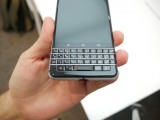
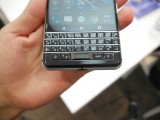
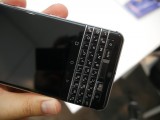
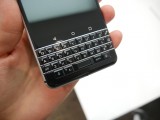
The keyboard that checks all the boxes
Plus, the impressive Priv keyboard scrolling gestures are here once again. Simply swipe a finger across the keys vertically and horizontally and the OS will respond in a surprisingly fluent matter, either scrolling or flipping pages. There is also a fingerprint reader conveniently embedded in the spacebar, which ties in nicely with BlackBerry's security focus.
Since we mentioned the OS, we don't really have too much to comment on in this department, since it is just as preliminary as the unit itself. However, we did manage to pry out that it is based on Android 7 Nougat. Just like on the Priv, which we reviewed some time ago, the overall UI appeared pretty close to stock Android. The most notable addition, of course, being BlackBerry's trademark suite of security and communication apps. Traces of these were already visible, even in the early software.
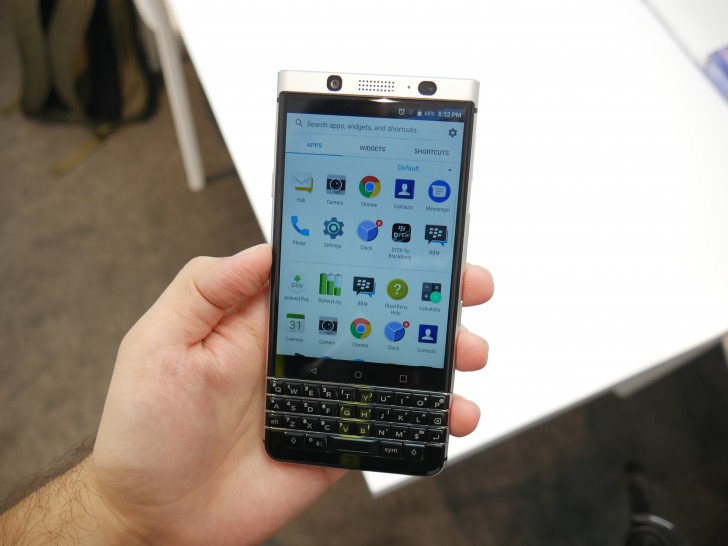
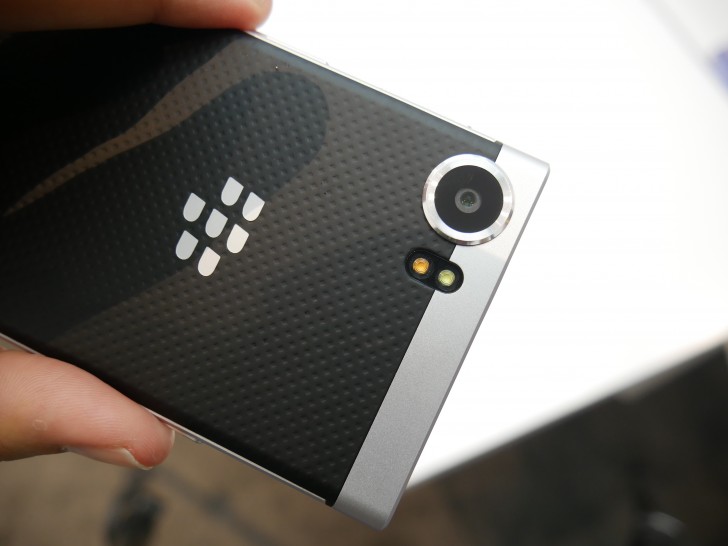
Sadly, that's about as much information as we managed to gather on the nuts and bolts. However, since we did get to actually touch the device itself, there are a few more notes to be made on its physical appearance. To finish up with the front, the top bezel offers a somewhat unconventional design. Instead of going with plastic or glass all around the panel, TCL has opted for the same brushed aluminum that makes up the rest of the shell, including the bezels and some of the back.
It definitely looks stylish and all the hardware, including the camera is prominently put on display. This makes a lot more sense than trying to conceal the openings, in our opinion, since the keyboard is already there and you might as well embrace the busy front aesthetic.
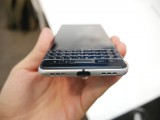
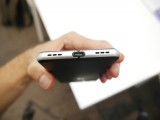
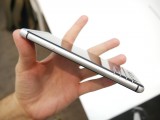
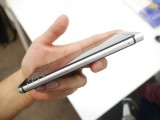
Metal all around
All that aluminum makes the body of the Mercury feel exceptionally sturdy. The device is a little bit bulky, especially in the thickness department, but that is hopefully indicative of a big internal battery. Plus, it feels great in the hand.
A lot of this comes courtesy of the soft-touch material, found on most of the back on the phone. It comes off as a cross between suede and matter plastic, leaning more towards the latter. In any case, the benefits to grip become instantly apparent.
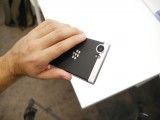
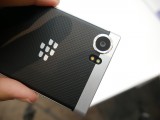
Metal and soft-touch materials tend to stand out in a glass-first design future
Venturing past this point in the overview, sadly leads squarely in the realm of speculation and assumption. We do already have the Mercury in our specs database as a rumored device, with the DTEK70 moniker as it's rumored to be called. Putting various bits and pieced together, we might be looking at a 1080p resolution on the panel, 4GB of RAM, 64GB of storage, a 13MP, plus 8MP camera setup and perhaps the Snapdragon 821 SoC. Although, a certain rumor did also hint at a more mid-range Snapdragon 625 chip and an unconventional 1620 x 1080 panel resolution.
Sadly, we just have to be patient and wait things out until MWC comes along. Until then, if it didn't become apparent already, let us reaffirm our excitement with the direction BlackBerry seems to be heading. The future looks bright and hopefully it stays that way.


Comments
Post a Comment